I recently posted a request on two Facebook sites dedicated to debate and discussion between theists and atheists, religious and non-religious people. The posts were very explicit that I’m an atheist, I’m not looking to be converted or to be preached at but I’m actually trying to understand why people believe so that I might gain some insight into my own former mindset.
I was also clear that I would not unpick or in any way try to belittle or disprove anything my respondents told me. This was to help people feel confident to respond to my questions without anxiety. The two questions, specifically directed at theists were…
- Which/what God do you believe in?
- What convinces you that it’s real?
My initial expectation was that someone would make a comment that would match my own previous cognition so closely that I’d just ‘get it’. Unfortunately that was not to be. However as the responses came in (I read them all and tried to respond by thanking all the serious ones too) I noticed some patterns and themes emerge. That has taught me a great deal both about myself and about the mindsets of other interlocutors on these pages.
As I write this summary I need to be clear. I’m writing it from an atheist’s perspective because that’s what I am. It’s the only honest way to approach it from my point of view. So I will be critical at times of some of the ideas presented. However, that in no way means I’m trying to belittle those kind theists who responded. On the contrary I greatly appreciate your efforts to help me in my attempt to understand my own former self.
If you find yourself tempted to be annoyed at my little summary please ask yourself how you would have approached a similar exercise were you to discuss atheist responses to your own questions. There’s no hostility here. There’s no implied disrespect, just honest disagreement and an attempt, born entirely out of a sense of fair play, to let you know what I have made of your kindness in responding in such numbers to my questions. I genuinely am grateful to you for your help.
The vast majority of respondents, both theist and atheist were polite, friendly and surprisingly candid. That was a surprise. The most common original posts on these FB pages are thoughtless, insulting and intended only to ridicule those on the other side of the debate. Those posters, although still posting prolifically throughout the 48 hours or so that my post was getting hits, were almost completely absent from my thread. This is significant.
My assumption is that despite my former impression that theists, especially Christians online, are primarily hateful human beings those that take their faith seriously and are prepared to engage seriously too are very different. The loud, trollish minority may be the most vociferous but ask them a serious question and they melt away like shadows in the sunshine.
This seems also to be the case with atheists. There are those on my side too who delight only in belittling ‘the opposition’ but on the whole they also stayed away. I’m beginning to understand why one Christian actually found it necessary to point out, with some surprise, that I don’t actually hate Christians. In my experience few atheists hate Christians although many of us, myself included, strongly oppose the way that Christianity is used to promote bigotry and division. Perhaps we can all learn from this pattern of responses.
Of course, there were some who entered the conversation with hostility from both camps. The point I want to make here is that they were in the minority. On the whole we have far more in common than most of us realise and very few have any serious animosity toward the other if treated with respect.
Of those who were actually hostile I noticed a striking pattern. They all seemed to be attacking a straw man.
Theists tended to attack me for a range of inaccurate characteristics ranging from immorality to assumptions about my sexuality or my hatred of everything good. Some misrepresented my political affiliations (which I had not mentioned) and a few claimed that I really did believe in God but was being rebellious because I didn’t want to be judged. None of these are accurate but they do betray a rigid mindset that is unable to entertain a concept such as sincere disbelief without feeling threatened.
Atheists who came out fighting seemed to think that asking the question meant I was somehow traitorous to their side. This makes no sense to me. Even if I had been actively seeking God (I wasn’t and had made that clear) that wouldn’t have been treachery, just honest inquiry. Those people seem to me to be equally rigid in their thinking.
The ancient Greek philosopher, Aristotle once said that
“It is the mark of an educated mind to entertain an idea without accepting it”.
The few theists and atheists who came out fighting seem to me to have failed that particular test in spades.
A few theists chose not to answer my questions at all, or at least not question 2, preferring only to evangelise and offer to help me on my journey to know God. Most graciously accepted my explanation that, as I’d said in the original post, I wasn’t seeking communion with the divine but rather to understand my own mindset of 30 something years ago. Those who did not seemed just as rigid as the hostile ones (indeed two became just as hostile and I eventually blocked them both).
As a young man I think I exhibited some of that same rigidity and that was my first insight into my former cognition.
The vast majority of respondents were much nicer than these though. I found my theist (predominantly Christian) interlocutors to be surprisingly warm, friendly and candid in their responses. I think only one Muslim responded. At least I think he was Muslim. He never said. He offered to help me to know God by answering any questions I had but chose not to respond to the two questions I actually asked. A few weren’t really reminiscent of any religion I could recognise but were equally candid as they spoke about energy, the cosmos, feelings of warmth and connectedness but were generally vague. None the less I thank them too for their candour and good graces.
Of the majority who genuinely tried to answer my questions in good faith without hostility or evangelism a number of themes emerged. I haven’t tried to enumerate or rank them in any particular order as that’s not what this exercise was really about.
Most spoke of personal interactions with the divine. For some this was about feeling loved or cared for. For others it was about answered prayers and events they defined as miracles.
Others provided well worn apologetics which, although unconvincing to me seemed to count as compelling to them. I have no doubt that they were sincere and I thank them for their input. These too seem to reflect my own youthful justifications for my faith. I remember being impressed by ‘Paley’s watch’ argument or the more modern ‘Hurricane in a scrapyard’ version popularised by Fred Hoyle. Others talked about fine-tuning, an argument I wasn’t too familiar with all those years ago but which I’m sure would have been just as convincing to me as it evidently is to them.
This gives me another insight into my own former mindset. I was prepared to accept ‘evidence’ without really understanding the counter-arguments – so long as it matched my preferred narrative. It’s a form of confirmation bias.
Others were reliant upon those they saw as authority. One gentleman chose not to answer me on the page but rather directed me to his own pinned post. This was a compilation of what seem to me to be fallacious talking points supported by links to pseudo-scientific organisations such as the Discovery institute. Just as it was with me, epistemology seems to be lacking.
I should point out that, critical though I am of these arguments I remain grateful to all who responded and I have no intention of taking anyone to task over their reasoning. At least not here. I am always ‘up for a good debate’ and will be happy to talk to anyone who wants to discuss further but not on the original threads. Start another one and tag me if you would like to have those discussions. I gave my word that I wouldn’t dissect anyone’s arguments on the original two posts and I do not intend to break it.
I am writing this review from my own perspective. If I didn’t see flaws in your arguments I’d believe as you do and, of course, I don’t. Please take these thoughts in the spirit they are intended. They’re honest feedback because those who are interested have a right to know what came of their equally honest assistance.
Another thing that struck me was how sophisticated many of the arguments were. People talked about physics, cosmology, biology, evolution and abiogenesis. Others commented on geology and meteorology. Whilst these arguments might be useful for justifying a faith already present, I think it unlikely that they are the arguments that brought most people into the faith in the first place. That also resonated with my personal quest for insight.
What brought me into the church was personal tragedy and the need to feel cared for. But that’s not what I said when I was evangelising. I was much more likely to trot out the apologetics I had learned in church than acknowledge the more intangible, feelings-based truth about what actually convinced me.
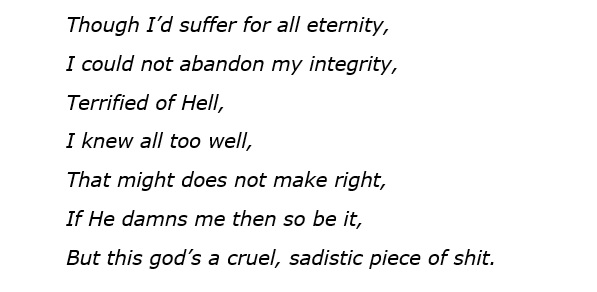
Some spoke of consequence and of Hell for non-believers, That also resonated. As a Christian I was perpetually aware that the Devil was always near, ready to trap me, to ensnare my soul and lead me to be cast into that lake of fire where I’d be tortured for all eternity. Once again, though – that’s not a convincer to get a person to enter the faith. It’s only frightening if you already believe. To those who don’t it’s no more threatening than the tooth fairy and just as imaginary. However I know from my own experience just how effective such a threat is in forcing Christians to self-censor, to reject their own thoughts and doubts as though the Devil himself were putting ideas into their heads.
It will take some time for me to really put all this together but I want to thank everyone who responded for their honesty, their openness and their willingness to assist someone from ‘the other side’ in a quest for personal insight.
Stuart Sorensen
June 2026